Who was stuck
Someone living with serious memory loss, in the middle of a conversation, who can't place the person in front of them or remember what they talked about last time. Many people cope with a paper notebook. It works, but it takes constant effort and it has gaps.
The first version is for younger adults with memory loss after a brain injury, stroke, encephalitis or epilepsy. Adapting it for early dementia, with more carer involvement, is the next step.
Part of what got me thinking about this was The Woman With the Seven Second Memory, a CBC documentary about living with amnesia.
Why it happens
Memory aids mostly ask you to write things down before you forget them. The hard part is the moment of the conversation itself, when there is no time to search a notes app and asking feels awkward.
What I built
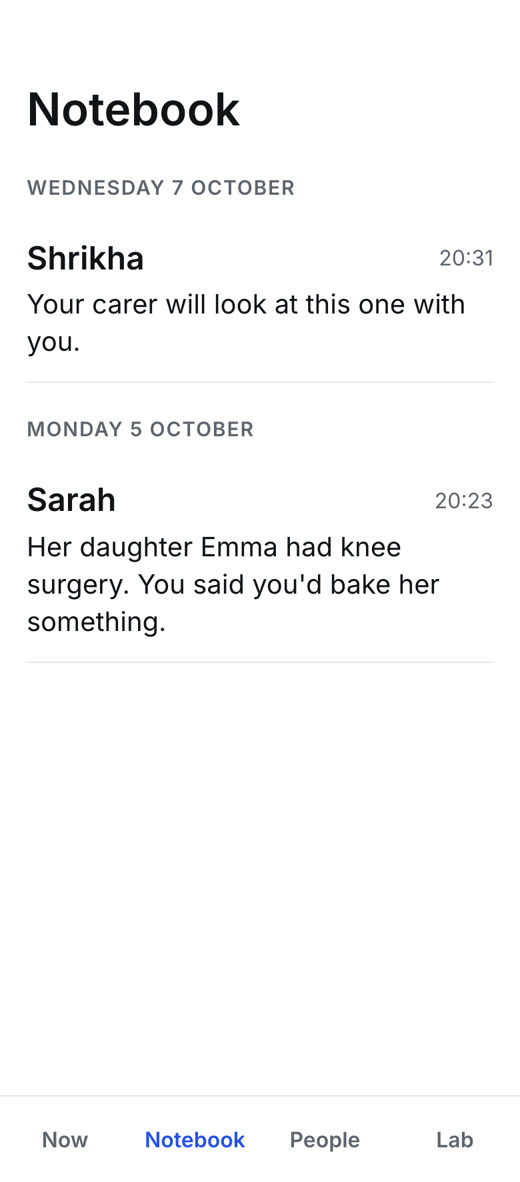
Memory Book shows who you're talking to and a short summary of your last conversation together, at the moment you need it.
- Press a button to start, and it ends on its own when the conversation goes quiet.
- A consent line at the start asks the other person for their name.
- A carer reviews the notes it makes, because anyone can say they're someone else.
- Designed for a smartwatch, so the button press becomes a habit rather than a chore.
The calls I made
A carer checks every note. Memory Book writes notes on its own, but anyone can walk up and say "Hi, I'm Sarah." If the app believed them, it would be easy to fool the exact person it's meant to help. So nothing it writes is shown as fact until a carer has looked at it.
You press a button to start. It would be easier to leave the mic on all day. I didn't want that, for the user or for the people they talk to. A button press is a small habit, it makes it clear when it's listening, and it stops by itself when the conversation goes quiet.
Did it work
The plan is a small pilot with three to five users and their carers. Success means at least three of five still using it after two weeks, and most saying it helped.
I haven't been able to test it with someone living with memory loss yet. If you know someone with amnesia, or a carer, who'd be open to trying it, I'd love to hear from you. Email me.